

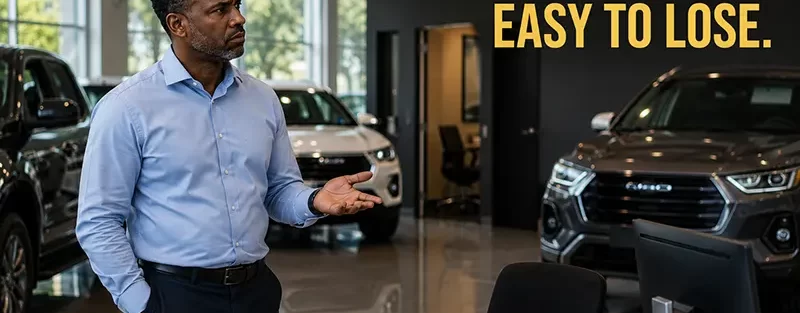
READY TO BUY. EASY TO LOSE.
A few months ago, I was in the market for a new vehicle.
Like most people, I visited several dealerships. I expected differences in price, inventory and customer service.
What I didn’t expect was that the experience would remind me of something I’ve been seeing across organizations for years.
My search began where I bought my current vehicle 10 years ago. But this time I started in the used vehicle lot. There were no prices on the vehicles and no salespeople in sight. Eventually I found someone in the office, explained I was looking for a 4–7-year-old pickup – figured it would be a better economical purchase, and left my contact details. They promised to call the following week when new inventory arrived.
I then visited the new vehicle showroom. Different salespeople. Same company.
The model I’d been seeing advertised wasn’t available. I looked at an alternative, was handed over to another salesperson, gave him my contact details, turned to look more closely at the vehicle… and when I turned back, he was gone.
The next dealership was completely different.
Reception greeted me at the door and introduced me to a salesperson. She listened to what I was looking for, showed me a model that was available in the showroom, answered my questions, and then introduced me to the finance manager. I then left to visit my third and final dealership. I hadn’t even reached them before an email arrived with two financing options from the salesperson I’d just met.
The third dealership showed me a brochure for a vehicle I liked but explained the showroom model wasn’t ready yet. They took my number and promised to call when it was available for a proper test drive.
Then I waited.
Weeks passed.
Apart from one dealership…
No one ever contacted me.
Not once.
The one dealership that did follow up deserves credit. They were clearly doing something the others weren’t. But even that wasn’t the full story. A few weeks later, the salesperson called to ask if I was still interested in the vehicle I’d seen—forgetting that we’d already discussed I was waiting for different inventory to arrive. The follow-up happened. The context had been lost.
At first, I thought this was simply a story about inconsistent customer service.
But the dealership that surprised me most wasn’t the one with the weakest sales process.
It was the one that had known me for years. The first dealership above I visited.
They had serviced my vehicle.
They knew its age.
They knew the parts I’d purchased.
Their WhatsApp messages greeted me by name whenever I enquired about parts.
At one point, they probably knew more about my vehicle than I did.
Yet when I entered the market for another vehicle…
I became a complete stranger.
The more I reflected on that experience, the more I realized it wasn’t really about buying a vehicle.
It exposed something I’ve been seeing across organizations for years—not just in automotive, but in hospitality, airlines, destination marketing organizations, financial services, retail, and many others.
The real issue wasn’t poor salesmanship.
It wasn’t inventory.
It wasn’t even bad technology.
I’ll share what I believe it was in my next post.
Until then, I’m genuinely curious.
What do you think was the biggest failure in this story?
Have you experienced something similar—as a customer or from inside your own organization?
Share your thoughts in the LinkedIn discussion.
https://www.linkedin.com/posts/egbert-riley-plci_two-months-ago-i-was-in-the-market-for-a-share-7480812102019096576-5P44/?utm_source=share&utm_medium=member_desktop&rcm=ACoAAAHWOZYBCpXMAVChU0UtDXKd177RPQBTmx4
If this story resonated, you may also be interested in assessing how well your own organization aligns marketing, sales and customer experience. Sales & Marketing Assessment – Purple Leaf Communications Inc