


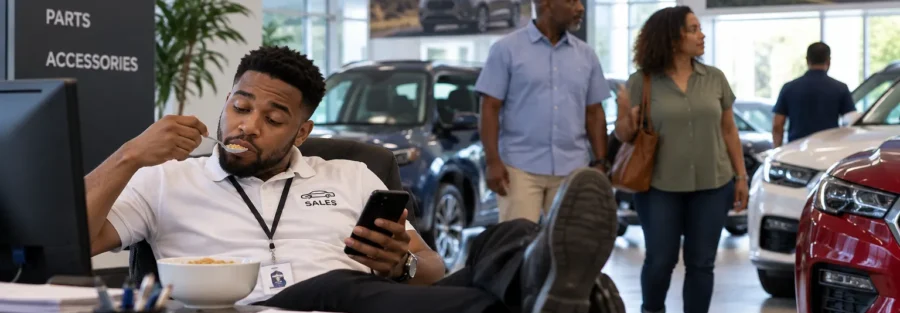
It happened again.
A while ago, I wrote about visiting three vehicle dealerships while looking for a new vehicle.
Each experience was different. But, with one partial exception, the outcome was the same.
I was a willing buyer.
They had my contact information.
And the opportunity simply disappeared.
Recently, I visited a new EV dealership.
This time, the in-person experience was much better. The salesperson was knowledgeable, attentive and helpful. Afterwards, I received an email with a link to explore their vehicle models.
And then…
Nothing.
No call.
No email asking whether I had questions.
No attempt to understand whether I was still considering a purchase.
Four dealerships. Four different experiences. Similar outcomes.
That got me thinking about some of the comments on my original post.
There were several explanations for what went wrong: poor follow-up, weak sales processes, disconnected systems and, especially, sales culture.
I think all of them may be symptoms of something broader.
Strategy execution.
If one of your primary objectives is to sell vehicles—and those sales subsequently drive financing, servicing, parts and future purchases—then identifying a prospective buyer is only the beginning.
Someone has to follow up.
Someone has to know what happened before.
Someone has to own the opportunity.
And the organization needs processes, people, data and technology that make those behaviours routine rather than accidental.
Strategy doesn’t always require doing something entirely new.
Sometimes it means doing what you’re already supposed to do exceptionally well.
World class.
Which brings me to something several people raised after my first post:
Culture.
There’s an old saying that “culture eats strategy for breakfast.”
I’m not convinced.
Or, more accurately, I think that statement lets strategy off the hook too easily.
Because if the culture required to execute your strategy doesn’t exist…
shouldn’t building and reinforcing that culture be part of the strategy?
That’s where I’ll pick this up next.